

If you are thinking about improving mobility in your home or project, you have probably felt overwhelmed by technical terminology.
The confusion around the differences between a home lift and a conventional lift is a common challenge that can cause concern: the fear of a never-ending building project, the worry that your parents could suffer a fall on the stairs, or the concern that electricity consumption may increase significantly.
Not understanding these differences can involve a major operational risk: you could end up installing a system that does not comply with regulations, paying more than necessary for monthly maintenance, or facing disruptive building work with a pit of more than one metre in the middle of your home.
The problem of confusion in vertical transport
The main issue when planning a mobility solution for the home is the lack of technical and regulatory clarity. It is common to assume that any system that moves up and down is a lift, when in reality there are very different solutions with completely different requirements.
This confusion can lead to unsuitable decisions right from the start of the project.
Common risks of making the wrong choice
- Installing equipment designed for buildings, not detached homes.
- The need for complex building work, such as a pit of more than one metre, which may not be structurally feasible.
- Mandatory periodic maintenance commitments, with recurring costs.
- Increased electricity consumption due to an oversized system.
How to avoid mistakes from the design stage
Before making a decision, it is essential to carefully analyse which technology truly suits the space, the intended use and the conditions of the property.
To do this, it is advisable to review the best tips for choosing the right lift for a home, in order to align the technical choice with the reality of the project and avoid additional costs later on.
What is the difference between a home lift and a conventional lift?

Although they may look very similar, the key to telling them apart lies in the regulations that apply to them and their structural design.
- Lift Directive, conventional lift: This regulates equipment intended for buildings with heavy vertical traffic, such as apartment blocks or hotels. These are machines with extremely strict safety standards, designed for constant use and higher speeds. They are usually governed by the Lift Directive, 2014/33/EU. They are designed for intensive use in multi-storey buildings, shopping centres or industrial facilities.
- Machinery Directive, home lift or reduced-speed lift: This is the legislation that applies to domestic or single-family home lifts. As they are intended for specific uses and moderate traffic, their regulations are more flexible, allowing for a simpler installation and a lower impact on the architecture of the home. In many cases, these low-speed systems are regulated by the Machinery Directive, 2006/42/EC. This simplifies their safety and construction requirements, making them the ideal solution for detached homes, villas or small premises where intensive use is not required.
In practice, a home lift is designed for simplicity. While a conventional lift requires a three-phase electrical supply, a modern home lift works with a 230V single-phase system, consuming a similar amount of energy to a large household appliance such as an oven.
Key speed differences between home lifts and conventional lifts
The technical factor that defines the legal boundary is 0.15 metres per second, m/s.
- Home lifts, low speed: These operate at a speed equal to or below 0.15 m/s. Although this speed may seem slow, it is ideal for homes with just a few floors, up to five levels, ensuring a smooth and safe journey for older people or users with reduced mobility.
- Conventional lifts, high speed: These operate at speeds above 0.15 m/s, with speeds between 1 and 3 metres per second commonly found in residential or commercial buildings.
This distinction is not just a matter of “speed”. Speed determines critical safety components, such as the type of overspeed governor, safety gear and control panel.
By moving at less than 0.15 m/s, the home lift does not require the same complex systems as a high-speed unit, which reduces costs both at the time of purchase and in long-term maintenance.
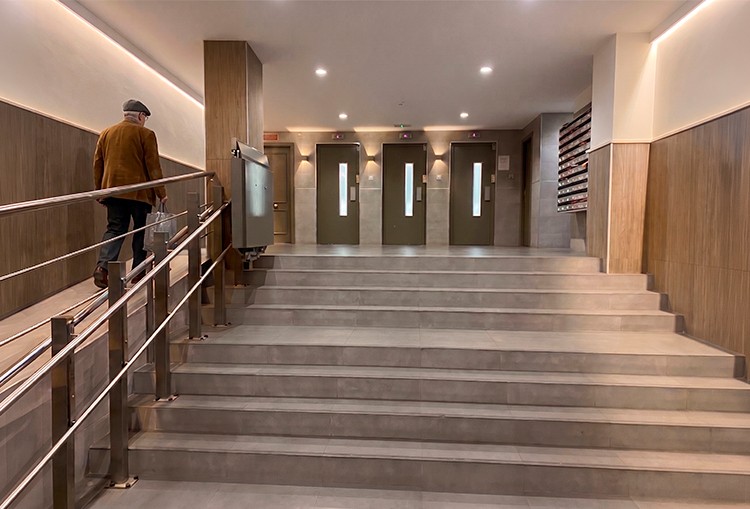
Key differences in installation and maintenance
For an architect or homeowner, installation feasibility depends on the building work required and the subsequent operating costs.
The pit and headroom
One of the biggest concerns in a renovation project is the lift shaft. A conventional lift requires a pit of approximately 1.2 metres deep. However, most current home lifts are pitless lifts or require only around 10 to 25 cm, avoiding the need to alter foundations or sensitive structural elements.
Spanish regulation maintenance
Both systems require legal maintenance, but the frequency changes significantly:
- Conventional lifts: The inspection must be monthly in almost all commercial cases.
- Reduced-speed home lifts: Regulations allow preventive inspections every 3 or 4 months, quarterly or four-monthly, significantly reducing the annual cost for the owner.
| Feature | Conventional lift | Home lift |
|---|---|---|
| Nominal speed | > 0.15 m/s | ≤ 0.15 m/s |
| Legal regulations | Lift Directive | Machinery Directive |
| Power supply | Three-phase, usually | 230V single-phase |
| Pit | Approx. 1.2 metres | 10–25 cm |
| Load capacity | From hundreds of kg to tonnes | 100 to 400 kg, generally |
| Maintenance | Monthly | Quarterly / Four-monthly |
Energy consumption and comfort
The fear of high electricity consumption is one of the main concerns when installing a vertical transport system at home.
Today’s home lifts are designed to be efficient, but consumption depends directly on the traction system. This factor is key to estimating monthly costs and avoiding surprises on the electricity bill.
Types of systems and their impact on consumption
- Hydraulic traction, piston system: This works through oil pressure. It tends to use more energy in certain movements, although it is robust and suitable for demanding loads or short travel distances.
- Electric traction, pulley system: This is a more energy-optimised system. It is the most common option in modern homes due to its efficiency and lower impact on the electricity bill.
How to make a decision based on data
To estimate real consumption and compare different scenarios, it is advisable to analyse a kW consumption comparison between hydraulic and electric lifts. This type of analysis makes it possible to calculate monthly costs more accurately before installing the system.
SHE-Elevator models are designed around single-phase solutions, helping to avoid the need to increase the contracted power supply at home and simplifying both installation and energy management.
Safety, aesthetics and property value
Installing a SHE-Elevator system offers benefits that go beyond mobility. Our models, such as the SHE 001 elevator for confined spaces or the SHE 003 with automatic doors, allow you to:
- Independence: Helping a wheelchair user regain full autonomy at home.
- Property value: An accessible home can increase in market value by up to 20%.
- Design: We offer customisable finishes that allow the cabin and enclosure to blend in with the home’s interior design, far from the cold, industrial appearance of standard lifts.
Frequently asked questions about home lifts and conventional lifts
Is a home lift safe during a power cut?
Yes. Our home lifts include automatic rescue systems. In the event of a power cut, the unit uses its batteries to descend smoothly to the nearest floor and open the automatic or semi-automatic doors, allowing the user to exit safely.
Is registration in the lift equipment register mandatory?
Yes. Any system used to lift people must be legalised and registered in the Lift Equipment Register of the relevant autonomous community to ensure that it complies with all safety inspections.
Can I install a home lift if I do not have space for a pit?
Absolutely. Pitless home lift solutions are available and can be installed directly on the existing floor or with a minimal ramp, making them ideal for already-built villas and detached homes.
Do I need a special electrical supply?
Not for a standard home lift. They work with the usual 230V single-phase supply found in any home.
Is a speed of 0.15 m/s enough for a villa?
It is the perfect speed. For a journey of 3 or 4 floors, the time difference is only a few seconds, but the benefits in smoothness, energy savings and maintenance simplicity are significant.
Choose the smartest solution for your home
The difference between a home lift and a conventional lift is not just a matter of words, but of speed and regulations. While the conventional lift is the machine designed for large buildings and heavy traffic, the home lift is the smart, cost-effective and aesthetic solution for the home.
At SHE-Elevator, we specialise in low-speed lifting systems designed to remove architectural barriers with maximum efficiency.
We help you integrate the lift shaft into your architectural project or renovate your current home so that accessibility becomes synonymous with comfort, not technical concerns.
