

Installing a mobility solution in your home is not just a simple purchase; it is a decision that transforms your daily life by providing safety, comfort, and increasing the value of your property.
To make the right choice, you should compare different elevator models by evaluating space, technology, and design, ensuring a long-lasting investment with no regrets after installation.
What are the problems associated with choosing the ideal lifting system?
Limited space in existing homes
One of the biggest challenges you may encounter is limited space, especially if you live in an already built home where fitting a cabin seems impossible. Often, the desire to improve accessibility clashes with the reality of not having a prepared shaft or facing invasive construction work that affects the structure of the house.
Insufficient technical planning
Another critical issue is the lack of technical planning, such as trying to install equipment in places where a traditional pit cannot be built due to garages or structural loads.
In addition, there is often significant terminology confusion. If you wonder what the difference is between a lift and an elevator, you should know that although they were previously distinguished, since 2013 regulations classify them all under the term elevator, differentiating them mainly by their speed.
Fear of an industrial look
Finally, many homeowners hesitate due to the fear of an overly industrial design. It is common to worry that the installation may look like something taken from a shopping mall, disrupting the aesthetics of the living room or entrance hall with cold materials such as stainless steel without warmth.
How to choose a home lift intelligently
To choose your home lift wisely and ensure a high-value investment, we recommend following these four key steps:
- Understand your space options: A preliminary study of the available shaft is essential in order to take advantage of compact configurations that avoid costly renovations.
- Define the required capacity: You should select a model whose load capacity and dimensions allow comfortable use, whether for a single person or for a wheelchair with a companion.
- Choose the right technology: The decision between electric or hydraulic systems will determine optimal performance depending on whether you need frequent use in small spaces or smooth movement over short travel distances.
- Customize the design: The lift should integrate into your home décor through elegant finishes such as wood, high-quality steel, or panoramic cabins that make use of natural light.
As manufacturers, we optimize direct production to offer the most competitive prices on the market without compromising high quality or technical requirements. Our goal is not to be the cheapest option, but the investment with the best quality-price ratio that fully adapts to your lifestyle.
Evaluate the real space and location
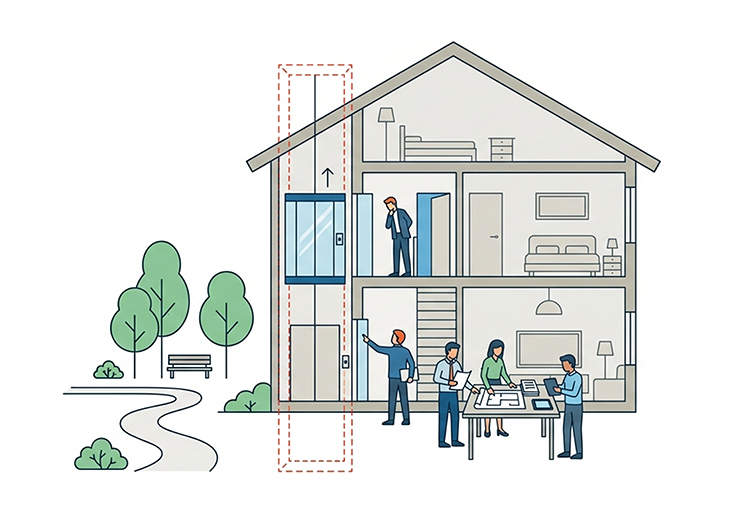
Before making a decision, it is essential that an expert carries out a preliminary study to measure the available space.
If you only have a very narrow area available, such as a staircase void, there are elevators designed to make better use of space through compact configurations that avoid expensive building work.
Define the capacity and daily use
Using the elevator alone is not the same as using it with a wheelchair or a baby stroller.
You should choose a model whose maximum load and cabin dimensions allow comfortable use. For example, a wheelchair with a companion requires more spacious solutions than those designed for individual use.
Select the traction technology
Choosing between electric and hydraulic systems will determine the performance of your equipment.
To help you make the right technical decision, it is important to understand the differences between an electric elevator and a hydraulic elevator. Electric models are ideal for frequent use and limited spaces, while hydraulic systems provide very smooth movements over short travel distances.
What should you consider when choosing an elevator for any home?
Safety and legality are key pillars that cannot be ignored if you want to avoid future problems with inspections or technical failures.
A properly installed unit must comply with the Machinery Directive 2006/42/EC if its speed is below 0.15 m/s, which is the standard for most installations in private residences.
- Mandatory maintenance: Since 2013, any device that travels more than 3 meters or connects two floors must have a maintenance contract and be registered with the Industry authority.
- Active safety: Your equipment must include automatic brakes, anti-fall systems, emergency buttons, and obstacle detection sensors.
- Initial inspection: By law, an inspection must be carried out before commissioning in order to obtain a favorable operating certificate.
When planning the installation, professional advice will help you understand how to avoid construction mistakes in your home, ensuring that the structure can support the loads and that the pit, if required, is properly built.
Regular maintenance is what will allow you to ensure long-term elevator safety while extending the lifespan of the mechanisms.
How to integrate design and aesthetics into your home
Your home is your refuge, and the lifting system should be part of its decoration, not an element that disrupts the harmony.
Modern scandinavian-style designs use glass and elegant finishes, allowing an elevator to adapt to the aesthetics of the home without looking like an industrial element out of place.
You can choose panoramic cabins that take advantage of natural light or customize materials with wood and high-quality steel. Ultimately, what you are buying is not just a machine, but the peace of mind of knowing your home will remain accessible forever.
Specific solutions according to needs
- Robust and complete option for multiple floors: Ideal for elevators for homelifts such as those from SHE-Elevator, ensuring reliability and comfort for longer travel distances.
- Improved accessibility: Accessible elevators for people with disabilities offer wider doors and spacious cabins, adapting to any accessibility requirement.
- Perfect for small spaces: Small home elevators are designed to fit into closets or minimal spaces without compromising functionality or style.
Comparison of solutions according to housing type
| Type of home | Recommended solution | Main advantage |
|---|---|---|
| Duplex | Compact systems | Minimal visual impact |
| House with garden | Panoramic structures | Integration with the landscape |
| Homes with elderly residents | Accessible models | Safety and full independence |
If your home has two floors, installing an elevator in a duplex allows convenient connection between levels without major renovation work.
Likewise, elevators for villas are designed with both capacity and aesthetics in mind, integrating harmoniously with the architecture of the home.
Frequently asked questions
Is maintenance mandatory even for private use?
Yes. Since 2013 it has been legally required to have a maintenance contract and be registered with the Industry authority for any equipment that connects two floors or travels more than 3 meters.
Can a lifting system be installed without a deep pit?
Yes. Some models are specifically designed to operate without a traditional pit by using self-supporting structures that adapt to floors where excavation is not possible, such as garages or delicate slabs.
What load capacity is most common in a home?
The typical capacity for a standard family is 2 to 3 people. However, if wheelchair access or frequent transport of heavy loads is required, models for 4 to 6 people are recommended.
How noisy is a home elevator?
Modern systems, especially electric models without a machine room, are designed to be extremely quiet, ensuring that their operation does not interfere with daily life or rest.
Invest in comfort, safety and future value
Choosing an electric lifting system is an investment that guarantees comfort and safety in your home. Thanks to their efficiency and reliability, these systems allow effortless movement between floors while adapting to each person’s needs and complying with all current regulations.
Discover the perfect electric elevator for your home. Contact our experts and schedule your personalized study to transform your house into an accessible, comfortable, and modern space.
