

Installing a lift in your home is a smart decision that improves quality of life, although it is normal to wonder whether this added convenience will ruin your monthly budget.
You should know that, thanks to technological advances, the energy consumption of a lift in a domestic setting is much lower than you might imagine and does not have to mean an unaffordable impact on your electricity bill.
What real variables affect household consumption?
The annual electricity consumption of a lifting system in your home is not fixed, as it depends directly on various technical factors and your lifestyle. It is essential to understand that lift energy consumption is mainly influenced by the model chosen, how often you use it, and the specific features of its installation.
The main variables that determine consumption are:
- Traction system technology: Modern electric systems are considerably more efficient than older hydraulic models.
- Load and traffic: The number of daily trips and the weight carried by the cabin on each journey affect the motor’s workload.
- Lighting systems: The type of bulbs used and whether they have automatic shut-off constantly influence consumption.
- Maintenance condition: Poorly maintained equipment or a lack of lubrication on the guide rails can increase friction and raise energy consumption unnecessarily.
If you want to look more closely at the numerical details, you can learn more about the electricity consumption of a lift to understand how these costs are broken down in your monthly bill.
Is it necessary to contract more electrical power for the lift?
A very common question is whether you will need to increase your contracted electrical power to prevent the fuses from tripping when installing a lift at home.
Consumption before and now
| Before | Now |
|---|---|
| Many elevators requiredindustrial three-phase installation | Many models operate with a220 V single-phase connection |
| More complex electrical installations | They connect like ahousehold appliance |
| Higher power consumption | Greater energy efficiency |
Consumption of modern lifts
Current models are designed to consume very little energy:
- Some home lifts require only around 500 W of power
- That is less consumption than many kitchen appliances
- They operate using the standard electrical installation of a home
So, do you need to increase your contracted electrical power?
In many cases, it is not necessary:
- There is no need to change the electrical certificate
- You do not need to increase your contracted power
- You will not pay more each month for contracted power
Energy-saving advantage at homes
This efficiency is especially important in electric lifts for homes, as they are designed to:
- Integrate easily into the domestic electrical network
- Avoid major building work or electrical modifications
- Reduce energy consumption
How does energy efficiency affect long-term savings?
Energy efficiency is not just an eco-friendly label; it is a direct strategy to reduce your fixed expenses and increase the value of your property. By choosing equipment with a high rating, such as Class A according to the VDI 4707 standard, you ensure optimal electricity use both during operation and when idle.
There are key components that make a real difference in savings:
- Optimised traction systems: High-efficiency motors designed to maximise mechanical performance and minimise energy loss on every trip.
- Frequency inverters: They allow smooth starts and stops, avoiding peaks in electricity consumption and significantly extending the motor’s service life.
- Smart standby management: These systems automatically switch off lighting and secondary functions when the lift is not in use, eliminating phantom consumption.
Discovering the electricity savings of having a lift at home will help you see how quickly these technologies pay for themselves through lower electricity bills.
Why is lighting a critical factor in energy consumption?
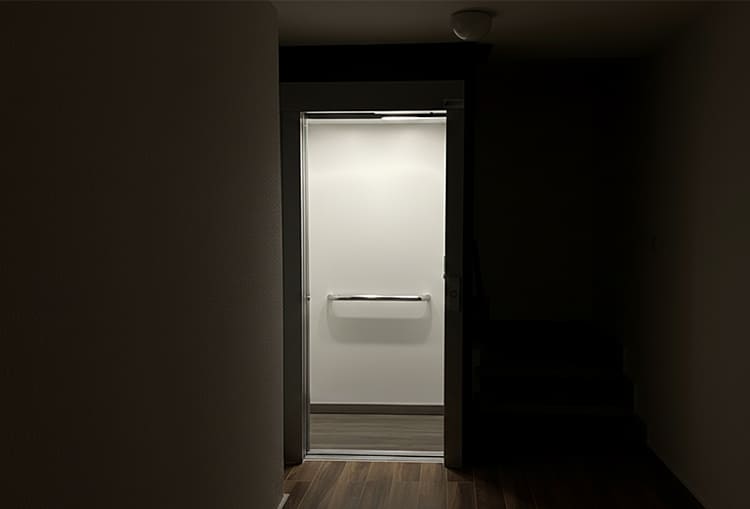
Although the motor is the most visible part, cabin lighting is estimated to account for between 10% and 12% of a lift’s total energy consumption if not properly managed. Keeping the lights on 24 hours a day is a common mistake that unnecessarily increases costs.
To optimise this aspect, you should look at two solutions:
- Use of LED technology: These bulbs consume up to 80% less than incandescent ones and have a much longer service life, which also reduces replacement costs.
- Automatic timed shut-off: This is a system that detects, through presence or motion sensors, whether someone is in the cabin. If the lift is empty and stationary, the lights turn off automatically, eliminating wasted energy.
What impact does the type of traction system have on your bill?
When choosing a lift, you will find two main systems: electric and hydraulic. It is important to know that:
Hydraulic systems are usually less efficient, as they consume more energy during ascent.
Electric traction systems with a counterweight are inherently more efficient, reducing the motor’s effort and optimising energy consumption.
How the efficiency of the electric system works
- The counterweight balances the weight of the cabin and the rated load.
- This significantly reduces the effort the motor must make.
- In certain cases (descending with a load or ascending empty), the system can even generate or recover energy if it has the appropriate technology.
Technical note: Traction not only determines consumption, but also space optimisation and comfort. If you are hesitating between an electric or hydraulic system, discover how to choose the perfect lift for your home in our specialist guide.
Solutions for homes with space limitations
For homes with building constraints, our small lifts for homes are the ideal solution:
- They adapt to compact spaces without compromising the structure.
- They maintain low energy consumption, integrating with the domestic electrical installation.
- They combine comfort, safety, and efficiency thanks to modern technologies.
This anchor points directly to the product, highlighting its practical value and efficiency without interrupting the explanation about traction and energy savings.
How does the traction system influence your savings?
A lift’s traction system directly affects energy consumption and, therefore, the long-term cost on your electricity bill.
In general, modern systems are designed to minimise the motor’s effort and optimise every movement, which results in greater efficiency and lower consumption.
Factors affecting consumption
- The effort made by the motor
- The balance between the weight of the cabin and the load
- Efficiency during ascent and descent
When the system is well balanced, the motor needs less energy, thereby reducing consumption.
Energy recovery
Some advanced systems can recover energy in situations such as:
- The cabin descending with a load
- The cabin ascending empty
This further improves the lift’s energy efficiency.
Energy savings and informed decisions
To make an informed decision, it is important to understand the comparison of kW consumption between a hydraulic and a non-electric lift, as this choice affects both comfort and the savings you will see month after month on your energy bill.
This analysis will allow you to:
- Understand how the type of traction affects your consumption
- Choose the most efficient option without compromising comfort
- Optimise long-term energy expenditure
Is maintenance an investment that helps you spend less?
Although lift electricity consumption is low, many users fear that breakdowns or poor efficiency may increase operating costs. The solution is preventive maintenance carried out by specialists, which ensures that lift energy consumption remains under control throughout its service life.
How maintenance affects consumption
- Correct lubrication of the guide rails: It can reduce peak power by up to 1000 W on each trip.
- Smooth equipment operation: The motor works less and therefore consumes less energy.
- Detection of obsolete components: This makes it possible to replace parts with more efficient versions, improving the overall performance of the lift.
Regular maintenance not only prevents costly breakdowns, but also optimises electricity consumption, extends the lift’s service life, and ensures safe and efficient operation.
How can accessibility be improved without driving up costs?
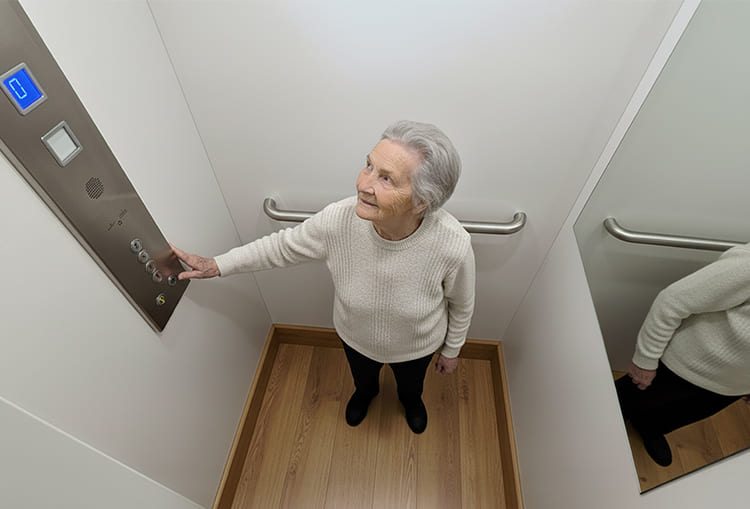
Accessibility should not be seen as an extra cost, but as an investment in comfort, independence, and the value of your home. To achieve this without disproportionately increasing costs, it is essential to choose efficient solutions adapted to the available space.
An ideal example is lifts adapted for people with reduced mobility. This model is designed to:
- Integrate into small spaces, making the most of the available shaft without complex building work.
- Minimise electricity consumption, operating only when necessary and optimising consumption on every trip.
- Offer spacious cabins and efficient automatic doors that combine comfort and practicality.
- Comply with strict safety and dimension regulations, guaranteeing full accessibility.
With this solution, you can improve your home’s accessibility efficiently, without driving up your electricity bill or installation costs, making accessibility a real and sustainable must-have.
Frequently asked questions about lift energy consumption
Does a lift use a lot of electricity when it is not being used?
Not necessarily. Modern equipment includes energy-saving functions that put the system into standby mode, switching off lights, fans, and displays, which reduces idle consumption to minimal levels.
Can solar energy be used to power a domestic lift?
Yes, there are already solar lifts that can be completely autonomous. If solar panels capable of generating between 1,800 and 2,100 Wh/day are installed, the energy balance can be zero, completely eliminating electricity bill costs.
What happens to consumption if there is a power cut?
Many latest-generation lifts are equipped with energy storage units. This not only improves efficiency during start-up, but also allows the equipment to continue operating for more than 100 trips without mains power, ensuring that nobody gets trapped and maintaining safety without extra cost.
Is it better to replace an old lift or modernise it to save energy?
In many cases, modernising the key components (what is known as an energy-efficient package) can offer savings similar to those of new equipment. Replacing the old motor with a direct-drive one and switching lighting to LED are steps that drastically reduce energy consumption.
Invest in comfort, safety, and future value
Having a modern lift at home is no longer an industrial luxury. By understanding lift energy consumption, you will discover that:
- Its consumption is comparable to that of other household appliances.
- There are ways to optimise its use and reduce costs.
- It improves the comfort, safety, and value of your home.
Consult our experts to find out which lift best suits your home.
