

The new ITC lift regulations, approved through Royal Decree 355/2024, are now a fully established reality in Spain.
This regulation unifies safety criteria for all lifts, ensuring that both new and older equipment meet modern protection standards for your family and pets.
What is the new ITC-AEM 1 and why was it approved?
The complementary technical instruction ITC-AEM 1 was created to modernize lift regulations, adapting them to current technological advances.
Its main objective is to improve safety in buildings, focusing on:
- Accident prevention
- Improved industrial safety
This regulation is especially relevant because:
- It introduces mandatory minimum measures for existing lifts
- It affects equipment that had not been adapted to the latest European directives
- It strengthens user protection in all types of buildings
In addition, it simplifies lift legislation in residential buildings, making it more consistent across all autonomous communities.
Key information:
- Effective date: July 1, 2024
- Compliance: mandatory for all lift owners
- You can consult the full text in the official BOE
What is considered a home lift under the new law?
The regulation defines a residential lift as a building intended for a single household. This point is key to determining which requirements apply in each case.
The following are also considered single-family home lifts:
- Equipment installed in existing homes for accessibility reasons
- Equipment serving only one floor
- Equipment whose owner is a private individual
- Equipment intended for the exclusive use of that owner
Mandatory requirements:
- They must be registered with the competent authority of the corresponding autonomous community
- They are assigned an RAE number (Lift Equipment Register)
Important:
- The RAE number must be visible on an identification plate inside the cabin
- This makes it easy to verify that the lift is legally registered
Changes in maintenance, visits depending on the type of equipment
With ITC-AEM 1, the frequency of inspections is adapted to the use and characteristics of the lift, making maintenance more efficient and safer.
Maintenance frequency:
- Speed ≤ 0.15 m/s (low speed): inspection every 4 months
- Speed > 0.15 m/s (conventional speed): more frequent inspections, as required by the regulation
Maintenance plan:
The maintenance company must prepare a customized maintenance plan.
- Based on UNE standards, especially UNE 58720
- Adapted to the type of lift and its use
Owner’s obligations:
- Keep the maintenance contract
- Keep the commissioning record
- Keep this documentation for at least 10 years
Deadlines and responsibilities for lift inspections
Your lift must undergo a periodic inspection carried out by an authorized inspection body, known as the OCA lift inspection. For single-family homes, the general inspection interval is every six years.
There are other intervals depending on the characteristics of the building:
- Industrial or public-use buildings: every two years
- Buildings with more than 20 dwellings or more than 4 floors: every four years
A key new feature is that now you, as the owner, are directly responsible for arranging the inspection. The maintenance company must notify you of the date three months in advance, but it cannot hire the service on your behalf in order to ensure transparency.
Safety measures you may need to install

The complementary technical instruction for lifts requires older equipment to be adapted with new safety measures (ISAE). These are the seven main improvements you may need to implement in your equipment:
| Safety measure | Main benefit |
|---|---|
| Accurate leveling | Stops the cabin within ±10 mm to prevent tripping when entering or leaving. |
| Door protection | Infrared light curtains to prevent impacts on children and pets. |
| Two-way communication | Cabin button to speak with a 24/7 rescue center in case of entrapment. |
| Load control | Device that prevents movement if the maximum permitted weight is exceeded. |
| Guide replacement | Replacement of wooden or cylindrical guides to improve emergency braking. |
| Counterweight safety | Measures to prevent falling weights and allow full inspection. |
| Uncontrolled movements | Devices to prevent the cabin from moving on its own with the doors open. |
It is essential to check how often a lift must be maintained and verify whether these measures are already present in your installation. Many of them are intended to correct the most common risks detected in recent years.
When it is mandatory to adapt your lift and what the deadlines are
You do not have to carry out all changes immediately unless there is a serious and imminent accident risk detected by the technician. Most of these improvements are required after the first official periodic inspection that reports their absence.
There are specific deadlines for certain measures once they are detected in an inspection:
- Lack of leveling: if it has caused a previous accident, the deadline is six months
- Door protection: one year from the unfavorable periodic inspection
- Two-way communication: one year to install the device from the date of notification
Differentiating between urgent repairs and planned improvements will help you better manage home maintenance. Your maintenance company must inform you in writing which elements must be replaced based on the risk identified.
Benefits of the new ITC for the owner
Complying with the new ITC lift regulations offers real advantages that go beyond simple legal compliance.
The most direct benefit is safety for your family, since updating the equipment significantly reduces the risk of entrapments, falls, or malfunctions. This makes day-to-day use of the lift more reliable and reassuring.
It also increases the value of the property, because a lift that complies with the 2024 regulations is perceived as more modern, safer, and more attractive in the real estate market, which can positively influence its value.
In terms of consumption, improved energy efficiency also stands out, with systems that optimize the operation of the equipment. For example:
- Automatic cabin light shut-off
- Reduced energy consumption during unnecessary stops
- More efficient daily use management
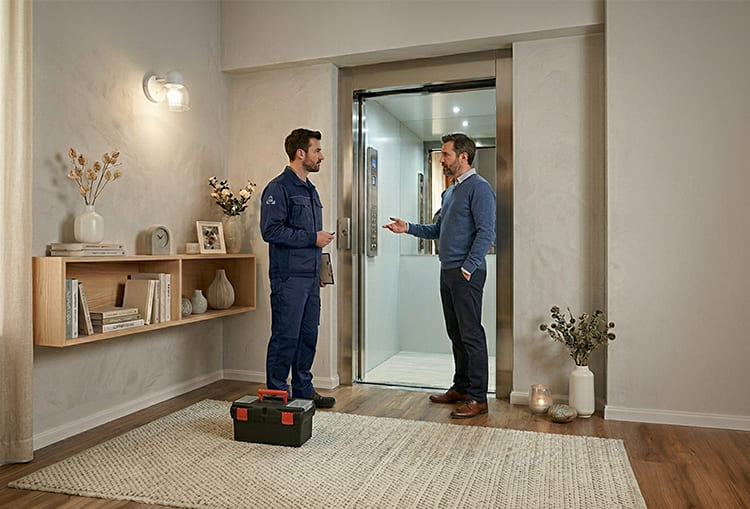
Finally, new preventive and customized maintenance plans help reduce breakdowns and long-term costs, since the lift operates more steadily, suffers less wear, and extends its service life more safely.
Frequently asked questions
What happens if my lift does not have the RAE registration number?
If your lift is old and is not registered, you must regularize its status before the competent authority in your autonomous community. The maximum deadline for this procedure is usually one year from the publication of the regulation in order to avoid penalties.
Can I change the maintenance company under the new law?
Yes, you can change companies as long as you communicate it in a way that leaves a record. You must provide the new company with the previous maintenance record in order to preserve the technical information and the equipment history.
Who must pay for the required safety upgrades?
The responsibility for keeping the lift in safe condition and paying for the necessary adaptations lies with the owner of the installation. Failing to carry out these improvements within the legal deadlines is considered a serious defect during inspections.
Conclusion and how to adapt to the new ITC
The new ITC for spanish lift regulations mark a before and after in the protection of homes in Spain. Do not see these changes as a burden, but as an opportunity to improve the quality of life and safety of those you care about most at home.
Keeping up to date with the regulations will give you peace of mind, knowing that your equipment complies with the highest safety standards today. At SHE-Elevator, we are experts in helping you navigate these changes without complications.
Next steps:
- Contact experts to carry out a lift audit
- Check whether the equipment needs adaptations to the new ITC
- Receive advice to comply with the regulations without complications
Contact our specialists to audit your equipment and find out whether you need to adapt your lift to the new ITC. We help you stay safe and comply with the law in a simple and hassle-free way.
