

Maintaining a home lift involves much more than simply checking that the lift car travels up and down correctly. During a maintenance visit, a qualified engineer inspects different parts of the system, checks the safety devices, assesses how the lift is operating and carries out the work required to keep it in good condition.
For homeowners, understanding what happens during a maintenance visit has a clear advantage: it makes it easier to know what is being checked and to recognise when a change in the lift’s behaviour may need professional attention.
In this guide, we explain how home lift maintenance is carried out step by step, which components may be inspected and which signs should be reported to the maintenance company.
Important: the exact maintenance tasks will depend on the lift model, technology, installation configuration and maintenance schedule. This guide therefore explains the general process and does not replace the specific instructions for each lift.
What happens during a home lift maintenance visit?
A maintenance visit combines a number of inspection, servicing and preventative tasks.
Depending on the type of lift, the engineer may carry out:
- Visual and operational checks.
- Inspection of mechanical components.
- Checks on electrical and electronic systems.
- Inspection of doors and locking devices.
- Levelling checks.
- Testing of safety systems.
- Cleaning of certain components.
- Lubrication where required.
- Adjustments and fine-tuning.
- Operational tests.
- Recording of the work carried out.
The purpose is not to wait until the lift develops a fault, but to identify potential issues early and keep the equipment operating correctly.
How is a maintenance inspection carried out step by step?
Although every lift has its own specifications, a professional maintenance visit will usually follow the same basic approach: first checking the lift’s overall behaviour, then inspecting its individual systems and finally confirming that everything is operating correctly.
Checking the lift’s overall operation
The visit usually begins by observing how the lift performs.
The engineer may look for details that can easily go unnoticed during everyday use, including:
- How the lift car starts moving.
- How smoothly it travels.
- How it stops.
- Any unusual noises.
- Any vibration.
- Whether the lift stops correctly at each floor.
- How the doors operate.
- Whether the controls respond as expected.
This initial check helps identify any change from the lift’s normal behaviour.
For example, if a lift has always operated quietly and suddenly begins making a new noise, this is a change worth investigating.
Inspecting the lift car and landing doors
Doors play an essential role in the safe use of a lift and are subjected to repeated operation throughout their service life.
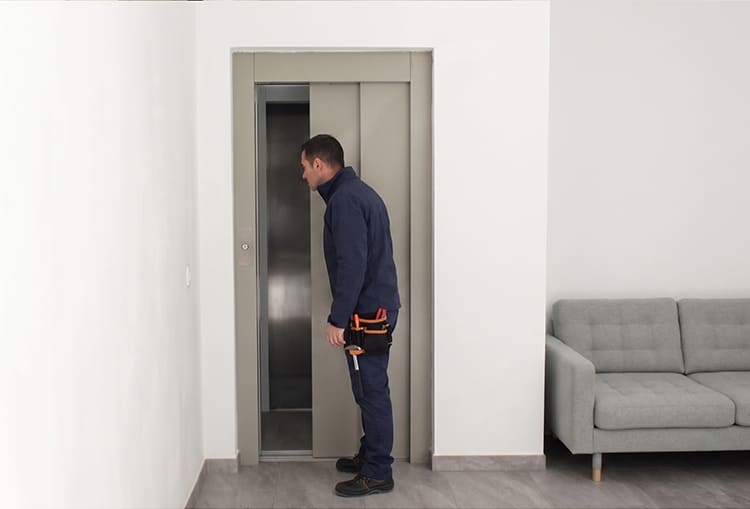
During maintenance, the engineer checks that the opening and closing mechanisms are working correctly and that the associated safety devices respond as intended.
Depending on the lift configuration, the following may be inspected:
- Door panels.
- Opening and closing mechanisms.
- Locks.
- Sensors.
- Detection devices.
- Guides.
- Moving components.
- Push buttons and controls.
A door that starts taking longer to close, makes an unusual noise or no longer responds as it used to should not simply be treated as an inconvenience. It may indicate that the system needs attention.
Checking lift car levelling
Levelling refers to the position of the lift car in relation to the landing floor when the lift stops.
During maintenance, the engineer checks that the lift car stops at the correct level.
Any difference from its usual stopping position may be linked to different components within the system and should be assessed professionally.
This is particularly important in homes where the lift is used by people with reduced mobility, children or older people.
Inspecting the mechanical components
The engineer inspects the mechanical parts involved in the movement of the lift car and the overall operation of the system.
Depending on the lift installed, this may include:
- Guide rails.
- Transmission components.
- Pulleys.
- Bearings.
- Fixings.
- Suspension components.
- Moving mechanisms.
- Lubrication points.
The purpose is to identify signs of wear, excessive play, deterioration, dirt or components that may need adjustment.
Where necessary, the relevant cleaning, lubrication or adjustment work is carried out in line with the lift’s technical requirements.
Not every component requires the same type of maintenance. A professional inspection should always reflect the specific characteristics of the installation.
Checking the traction system
In electric lifts, the traction system generates and transmits the movement required to move the lift car.
The engineer checks how the system is operating and how it responds during start-up, travel and stopping.
Among other things, they may look at:
- Noise during operation.
- Vibration.
- Behaviour during start-up.
- Smoothness when stopping.
- Condition of associated components.
- Signs of wear.
Any change in the lift’s usual behaviour may be a reason to carry out a more detailed inspection.
Inspecting the control panel
The control panel coordinates many of the lift’s functions.
During maintenance, the electrical and electronic components relevant to the particular lift model are checked, together with their connections and control systems.
Depending on the equipment, this may include:
- Connections.
- Protective devices.
- Control components.
- Sensors.
- Electrical signals.
- Electronic systems.
- Faults or incidents recorded by the system.
This part of the maintenance process is particularly important in modern lifts, where electronic systems are responsible for a wide range of functions.
Testing the safety systems
Safety checks are a fundamental part of any maintenance visit.
The engineer inspects the safety devices fitted to the lift and confirms that they are operating correctly for the specific installation.
These may include:
- Locking devices.
- Detection systems.
- Stop devices.
- Speed control or limitation systems.
- Two-way communication.
- Emergency lighting.
- Rescue systems.
- Other lift-specific safety devices.
The exact list will vary from one lift to another. The systems that need to be checked depend on the configuration of each installation.
Cleaning, lubrication and adjustments
Maintenance may also include work intended to preserve the condition and performance of specific components.
Where necessary, the engineer may:
- Clean components.
- Remove accumulated dirt.
- Lubricate mechanisms.
- Adjust components.
- Fine-tune specific parts.
- Check fixings.
These tasks should always be carried out in accordance with the lift manufacturer’s technical specifications.
More maintenance does not mean applying more products or making more adjustments. Professional maintenance should focus on the work the lift actually requires.
Final operational test
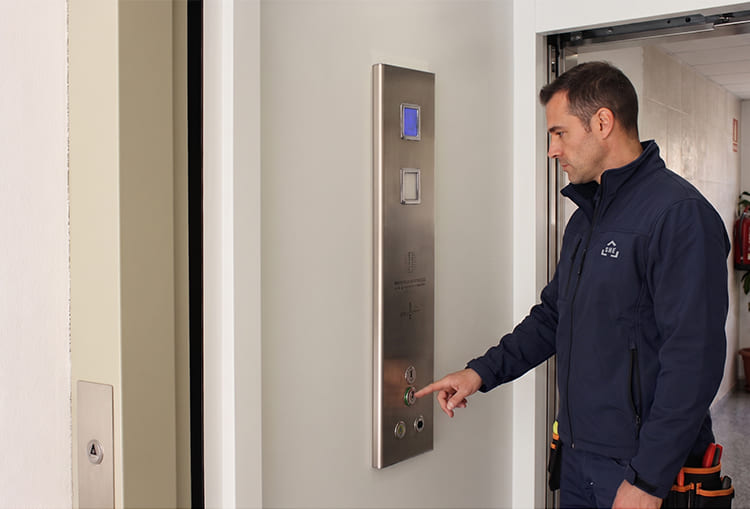
Once the relevant checks and maintenance work have been completed, the engineer tests the lift again.
Depending on the installation, this may include checking:
- Start-up.
- Travel.
- Stopping.
- Levelling.
- Door opening and closing.
- Response of the controls.
- Operation of the safety systems.
The aim is to confirm that the lift is operating correctly after the maintenance visit.
Recording the maintenance visit
A professional maintenance visit should also leave a record of the work carried out.
A clear maintenance history makes it easier to track the condition of the lift over time and is particularly useful when a recurring issue appears or when further work is needed later.
Maintenance records may include:
- What was inspected.
- Any issues identified.
- Adjustments made.
- Components worked on.
- Repairs carried out.
This means that each visit becomes part of the lift’s technical history rather than an isolated intervention.
What signs might an engineer identify during maintenance?
One of the most important purposes of preventative maintenance is to identify changes in the way the lift behaves.
Some examples include:
| Sign | What may need checking |
|---|---|
| New noise during travel | Investigation of the source |
| Vibration | Inspection of components and adjustments |
| Different stopping behaviour | Levelling and control checks |
| Irregular door operation | Inspection of mechanisms and safety devices |
| Less smooth start-up | Traction system check |
| Intermittent faults | Electrical or electronic inspection |
| Visible wear | Assessment of the affected component |
These symptoms do not in themselves identify the cause of a fault.
Their importance lies in showing that something has changed in the way the lift operates and that the cause should be checked professionally.
What can the homeowner do between maintenance visits?
Technical maintenance must be carried out by the lift maintenance provider, but homeowners can also help keep the lift in good condition.
Good practice is straightforward:
- Respect the maximum load.
- Do not hit or force the doors.
- Do not interfere with technical components.
- Keep entrances and landings clear.
- Report any new noises or vibrations.
- Let the maintenance company know if the lift no longer stops level with the floor as it did before.
- Report intermittent faults.
- Do not ignore changes in the lift’s normal behaviour.
A useful rule of thumb is:
If something changes from the lift’s normal operation, report it.
There is no need to wait until a minor issue eventually causes the lift to stop working.
Does maintenance vary depending on the lift technology?
Yes. The overall approach is similar, but the components that need to be checked vary depending on the technology used.
Electric lifts
For an electric lift, maintenance will pay particular attention to components associated with:
- The traction system.
- Motor.
- Control panel.
- Electrical components.
- Mechanical components.
- Safety systems.
Hydraulic lifts
With a hydraulic lift, the maintenance visit also includes the components specific to the hydraulic system.
These may include:
- Hydraulic power unit.
- Piston.
- Valves.
- Connections.
- Hydraulic circuit.
- Potential leaks.
For this reason, lift maintenance should never be based on a generic checklist alone. It must take into account the specific characteristics of the equipment installed.
If you are considering which technology may be more suitable for your property, see our comparison of electric and hydraulic lifts.
If you are still deciding which type of lift you need, you can also read our guide to choosing a home lift.
What is the difference between maintenance and repair?
They are two different types of work.
Preventative maintenance is intended to keep the lift in good condition and identify potential issues before they develop into faults.
A repair is carried out when there is an actual defect, failure or component that needs to be repaired or replaced.
A repair therefore does not replace preventative maintenance.
Likewise, finding an issue during a maintenance visit does not necessarily mean there is a serious fault. The engineer must first identify the cause and determine what action is appropriate.
What is the difference between maintenance and inspection?
These are also two separate processes.
Maintenance refers to the regular servicing and upkeep of the lift carried out by the maintenance provider.
A periodic inspection is a regulatory check carried out, where applicable, by an authorised inspection body.
This article focuses specifically on how technical maintenance is carried out.
If you would like to know more about maintenance frequency, owner responsibilities, lift registration, periodic inspections and other administrative requirements.
How can you tell whether a lift is being maintained properly?
For a homeowner, it is not always easy to know exactly what is happening during a technical maintenance visit.
There are, however, several indicators that can help assess the quality of the service.
There is a defined maintenance plan
Maintenance tasks should reflect the specific characteristics of the lift.
Different systems are inspected
A maintenance visit should involve more than simply confirming that the lift car moves. The relevant systems and components should also be checked.
Any issues are explained
If the engineer identifies wear or unusual behaviour, the homeowner should be informed and the recommended course of action should be explained.
The visit is recorded
A maintenance history provides a clear record of the work carried out and makes it easier to monitor the lift over time.
The approach is preventative
The aim should not be to attend only when the lift stops working, but to identify potential issues before they lead to a breakdown.
Frequently asked questions about home lift maintenance
What does an engineer check on a home lift?
The engineer checks the components and systems relevant to the particular installation, including mechanical and electrical components, doors, levelling and safety devices. Maintenance may also include cleaning, lubrication, adjustments and operational testing where required.
What is usually checked first during a maintenance visit?
The engineer will normally begin by checking how the lift is operating overall. This can reveal unusual noises, vibration, levelling issues, irregular door operation or other changes that may then need to be investigated in more detail.
Are the lift doors checked during maintenance?
Yes. Lift doors and their mechanisms are among the components that are inspected during maintenance, together with the relevant locking and detection devices fitted to the installation.
Why is lift car levelling checked?
Because a difference between the lift car floor and the landing can make entering or leaving the lift more difficult. A change from the lift’s normal levelling position can also indicate that a component needs to be checked.
What happens if the lift is making a noise?
The engineer will assess where the noise is coming from. It may be linked to a number of different components and does not necessarily indicate a serious fault, but any new or unusual noise should be investigated.
Are all lift components lubricated?
No. Lubrication depends on the component and the equipment manufacturer’s specifications. Applying lubricant indiscriminately is not part of professional lift maintenance.
Is maintenance the same for every lift?
No. The procedure depends on the lift technology, configuration, components, usage and the characteristics of the installation. The maintenance plan should therefore be tailored to the individual lift.
What should a homeowner do if they notice something unusual?
They should contact the maintenance company. New noises, vibration, levelling problems, door faults or any other change in the lift’s normal behaviour should not be ignored until the next scheduled visit.
How long does home lift maintenance take?
The duration of a maintenance visit depends on the type of lift, its configuration, the condition of its components and the checks that need to be carried out.
A routine visit may take around 30 minutes to one hour, although it can take longer if an issue is identified or additional work is required.
What happens if the engineer finds a problem during maintenance?
If an issue is identified, the engineer should assess its importance, determine which component is affected and decide what work is required.
In some cases, an adjustment or routine maintenance task may be enough. In others, a repair or replacement component may be necessary.
Good maintenance helps identify problems before they become faults
Regular maintenance helps identify changes in the lift’s behaviour, preserve its components and keep the system operating as it should. A professional maintenance visit combines technical checks, preventative servicing, safety inspections and a clear record of the work carried out.
At SHE-Elevator, we develop home lift solutions designed to suit the characteristics of each property.
